
The Mountainhead
Independence is interdependence

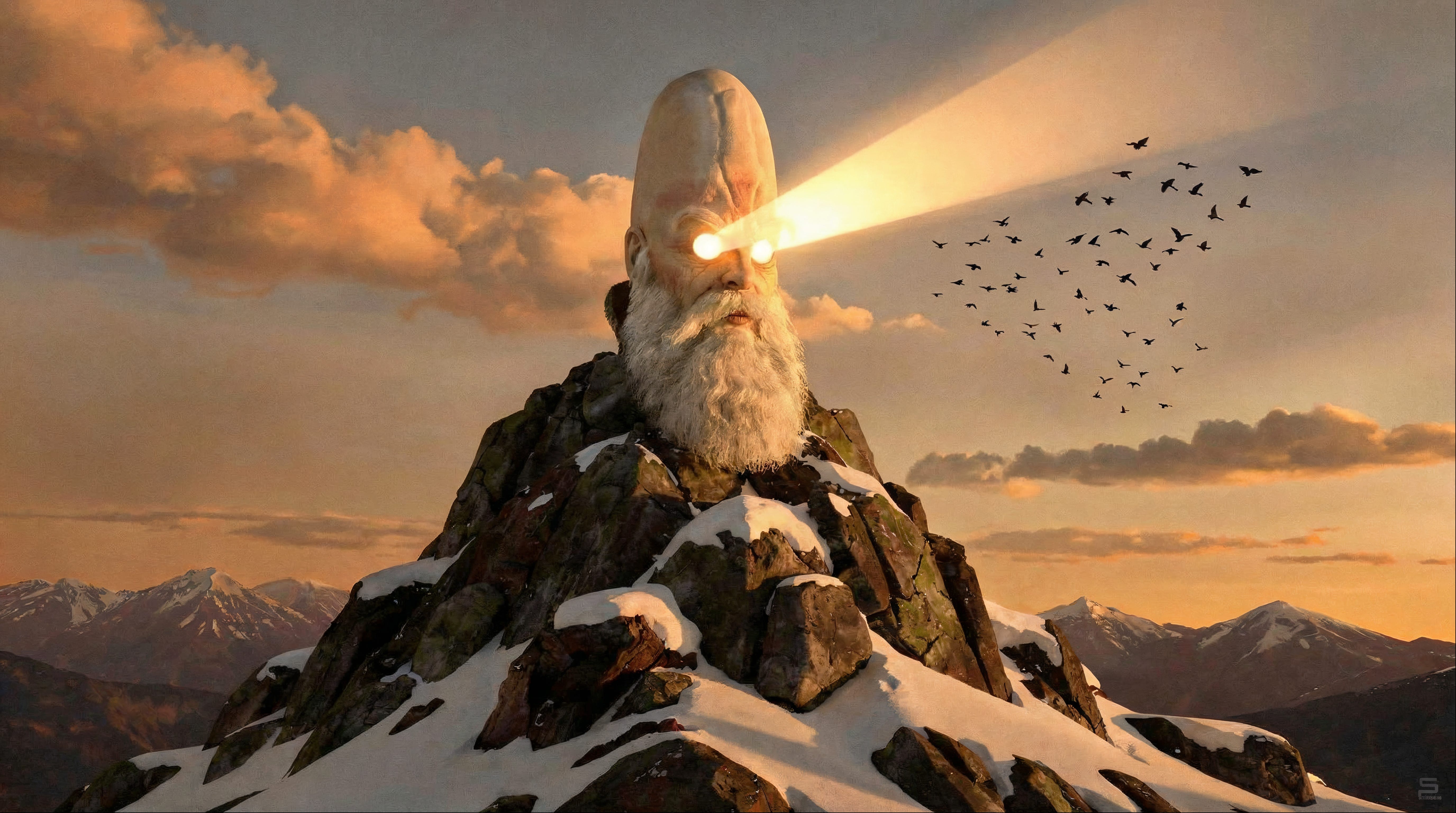
I found myself on a snow-covered slope, with a burning desire to reach the summit and a rifle. A distant voice called down to me, requesting a signal. I fumbled for my flashlight, and my gun went off, a sharp crack leapt into the mountain winds. A few shots were fired back, and I was hit. I blacked out.
When I regained consciousness, I sensed someone was with me. “You must listen to the instructions,” they said.
The old man was lying in the snow, frail and on the verge of death. A grand figurehead of a spiritual tradition. His head was long and conical. He was tended by another man, perhaps twenty years younger. The younger man held his hands around the throat of the old man and asked him, “Are you ready?” The old man nodded in reply.
The younger hands administered the act, and the old lips twisted. Not an act of violence, but one of reverence and compassion. A ceremony, conducted for centuries. Inevitable and natural. Death. Succession.
The head was easily removed and placed upon the peak. The headless body slid down the mountain. Black-winged pallbearers honored the discarded vehicle, cawing and pecking their respects. The younger man descended the path on foot; the older man’s head had now ascended, his eyes dead, but alight against the dusk, and ready to fight the approaching darkness.
He had become the mountain and the beacon…

Minor Spoilers in this essay for Vince Gilligan’s Pluribus, Hideo Kojima’s Death Stranding and Ursula Le Guin’s The Left Hand of Darkness.
Vince Gilligan’s Pluribus is made by humans, but something feels a bit ‘off’ with the show’s principal human; Carol Sturka is a professional ‘creative’ — a (reluctant) author of romantasy fiction. She’s an individualist who’s sold out to the crowds and, of course, resents her fans because of it. Let’s say she’s a challenging protagonist, to say the least.
Gilligan’s reputation solidified with Breaking Bad, an exploration of a man’s descent (or ascent) from good to bad. Now he seems to be taking another of our deepest dichotomies — the relationship between the individual and the collective.
Standing against Carol in the first season of Pluribus is most of the rest of the world’s population, merged into a single hive mind by a virus transmitted to us from outer space (and possibly from a 1960 Twilight Zone episode). The hive is mostly represented by Zosia, a ‘body’ they flew across the world to act as a romantically interesting envoy to Carol. The hivemind represents the concept of the collective, and we frequently see its corporeal constituents silently coordinating their actions and sharing their knowledge across the world, complete with the requisite resplendent bliss of a transcendent consciousness.
Superficially, the collective doesn’t seem like an antagonist any more than Carol is a protagonist. They have what appears at first to be moral imperatives; they can’t kill, eat meat, lie, or even refuse Carol and the twelve other remaining individuals. They exist to please and to use the planet’s resources as efficiently as possible. They’re an embodiment of almost any traditionally leftist value of the last 40 years. In Pluribus, the earth has been invaded by some sort of viral pacifist, pseudo-vegan, environmentalist, degrowth communist.
Strangely, in my experience of the show, I found myself in a kind of storytelling limbo that we don’t get exposed to that often — and it’s a testament to the sophistication of Gilligan’s storytelling and explorations of our humanity. Carol is an asshole, and Zosia (the Hive) is a creep. This may not be a story about who wins.
False binary
In one episode, Carol attempts to assert her independence. The Hive has emptied her local supermarket and turned off the city lights in a global effort to consolidate resources. Carol demands her right to find and cook her own food after the hive offers ‘room service’ every day. The hive, of course, cannot refuse Carol, and so we watch as hundreds of hive members go about unloading trucks and restocking supermarket shelves. It’s a stark reminder to us all of how our so-called freedom and independence are so heavily interwoven with the system and the effort of others.
Manussos is another of the few remaining individuals on Earth, and he becomes a kind of secondary protagonist by the end of the series. Rather than representing some kind of ‘middle way,’ he primarily acts as an ally and a foil to Carol. Manussos (who may have escaped from the hive’s connected state) knows what true independence and freedom take, and he resists all contact and assistance from them. He takes from absent others, but he borrows and never steals — leaving a trail of IOUs in his wake. He has his own fierce morality. In contrast to the supermarket scene, we see Manussos eating dog food from a storage locker rather than eating the ‘room service’ he is offered. He knows what it takes.
The story may be subtly leading us to a position where the hive and the individual are, in fact, co-dependent. Each produces the other as a necessary shadow. Carol’s individualism is defined only in opposition to the hive. The hive’s collectivism is depthless; it has no genuine self for Carol to connect with, only imperatives. Both see their relationship as a problem to be solved, either asserting the self against the group or dissolving it into one.
This is perhaps foreshadowed in a brief moment where Carol is reading Ursula Le Guin’s The Left Hand of Darkness. A story about an envoy to a new world, inviting the humans of that world into the galactic collective of the Ekumen. The story is a relationship between fundamentally different worldviews based on a biological schism. The population of the world of Winter is human but has no gender. Or more precisely, they only have a gender temporarily, during a period of ‘heat’ or ‘kemmer’ as it is called. Le Guin has imagined a world free of these gender constraints and archetypes that the protagonist Genly must open his mind to through a relationship with his local companion Estevan. In Pluribus, neither Carol nor the hive can see the other as a genuine other. Both treat the other as an it. The true relationship has not yet formed.
Where do stories come from?
Carol is a writer, and she plays to the archetype. It’s not uncommon for artists to see themselves as contrarian or outside of the systems they operate within. Carol obviously resents the system and openly makes creative choices in her work that will appeal to the crowds. Working in advertising for over twenty years now, I’m no stranger myself to the ‘ick’ of compromising truly interesting ideas for what works commercially. Carol also has her as-yet-unpublished ‘serious novel’. We all have our ‘Bitter Chrysalis’, don’t we?
She is the embodiment of friction, frustration, and pain. While the hive offers the bliss of a conflict-free world of efficiency and co-operation. It’s actually easier for us to imagine Carol’s world than it is to imagine the hive’s. That probably tells us something about being human.
We are still learning about the hive (it is season 1 after all), and there certainly are many open questions about its motives and its endgame. We do understand that the hive has access to all human knowledge, can communicate instantly, and at least walks and talks like a human. Sound familiar?
While the show was conceived prior to our recent boom in Artificial Intelligence, Gilligan has most certainly made his views clear on the subject since, describing it as the “world’s most expensive and energy-intensive plagiarism machine”. I can only imagine that it’s a highly intentional choice to make Carol an author — a creator of worlds, and it begs the question if creativity itself becomes the fulcrum of the relationship between the human and the alien. We see the hive coordinate, optimize, and serve (some pretty nice-looking meals at times), but have they ever generated anything new? Perhaps not yet.
Creation requires friction. A consciousness encountering resistance and making choices about that resistance. The hive, by optimising individuals into one consciousness, has removed conflict, and with it, the conditions for genuine novelty. They’ve traded the capacity for art for a world without war, and I’m not entirely sure which is the world I want to live in.
I hope that Pluribus presents us with something more nuanced than Gilligan’s openly stated opinions on AI. It seems to suggest that collective access to all knowledge still isn’t enough. The pattern that selects, arranges, and cares about ideas is the individual. The same substrate flows through everyone; it doesn’t produce the same work. Something is filtering. That something is a distinct aperture encountering the world. It may not emerge from the individual, and we may have no right to claim it, but we do choose it. AI can create — but it can’t choose from individual experience. That’s not a limitation of the technology. It’s a clarification of what authorship has always been.
Why individuation matters to the collective
The transcendent experience, whether religious, psychedelic or meditative, offers a glimpse of the universal oneness. The bliss the hive feels is real. And as alien as it seems, it’s attractive to us. Many traditions pursue it.
But one must become two. The ego is not the enemy of enlightenment; it’s the instrument. The one becomes more fully itself by encounter with what it is not. “Tat tvam asi/Thou art that” requires the thou to say it. It describes a relationship between the individual and the collective.
Personal sovereignty is something I’ve been thinking about lately on my own journey of individuation. But my subconscious seems to be asking me to hold these contradictions, and poses a question: Can sovereignty exist in relation? My vision of the Mountainhead was not the Fountainhead of Ayn Rand. The old man lost his body and became a beacon. A lighthouse at the top of the world, guiding others. Rand’s Roark has the light off. Sovereignty without relation. The fully realized Carol.
Bridges to build
Through the eye of the bird, we might begin to see solutions on the horizon. Imperfect models, but a direction nonetheless. The extremes of the sovereign individual are not unique to either side of politics, nor are the temptations of surrender to a collective. You need only to remember the transcendent bliss of HR asking you to surrender all objectives to a corporate strategy.
Hideo Kojima’s Death Stranding was one unique way for me to encounter a possibility: Anarchic Federalism. In this post-apocalyptic video game, you rebuild America after collapse — but not through conquest or central authority. You walk supply routes alone to isolated outposts, building bridges and roads that other players (in their own isolated games) will find and use. You see their constructions too, placed exactly where you needed them. Cooperation without coordination. Autonomy without isolation. You’re walking your own road, but you’re building infrastructure for strangers you’ll never meet.
Oosterwold in the Netherlands is a non-fictional example. A radical experiment in community self-organization where residents must grow food on their own land. You can’t free ride the hive there. It was designed to be a different way of planning a community, moving away from the strict, top-down regulation of the state collective to a more bottom-up, individual collaborative approach. Residents are even responsible for creating their own infrastructure, including roads, sewage systems, and water management. As of 2026, there is a growing waiting list for plots in this 10,000-acre development, which already hosts over 5,000 residents.
There are also open source software communities with individual authors and shared commons. Neither pure autonomy nor pure collectivism. You walk the road yourself, but you leave ‘bridges’ for others. Linus Torvalds created the Linux kernel in 1991, and still maintains ultimate authority over it. Thousands of developers across the world contribute patches, and each contribution is individually credited. The kernel is open source; it belongs to everyone. There is no central coordination; everyone scratches their own itch. It is infrastructure built by individuals and shared by everyone, without the center consuming the parts. It’s another form of Anarchic Federalism in practice.
These are all attempts to hold the tension rather than to resolve it. Even if Pluribus is not directly about AI, I can’t help but feel that Gilligan is prescient about the current state of America and the Western world. ‘E pluribus unum’ is printed on the money and the mythology of America. An empire built on the concurrent myths of the individual and the collective. The trajectory of our world hurtling toward platform capitalism, AI consolidation, and political polarization snapping between hyper-individualism and authoritarian collectivism, makes this story much more than a philosophical question. I’m looking forward to the second season.
Reconciliation will require revelation
One thing Manussos shows Carol is that autonomy is a practice, not a posture. Their sovereignty and independence only mean something in connection to others. It’s relational. It’s not a wall.
Pluribus hasn’t answered whether the hive will realize they need Carol as much as she needs them. Season two may reveal mutual recognition — or it may not. But the question Gilligan has opened is the question we’re living: can we hold independence and connection simultaneously, or will we keep collapsing into one extreme or the other? Carol’s cul-de-sac or the hive’s bliss.
Neither feels entirely… human.

Reading…
Funnily enough, I just read… The Left Hand of Darkness. Ursula K. Le Guin (1969). Now reading… The Secret of the Golden Flower (1932).
Research rabbit holes…
It’s been a while… Anarchism. Psychomagic. Qualia. Moksha and Gnosis. More down to earth… I’m figuring out how to install Solar Panels and trying Mesh Networking.
Sneaky peaky
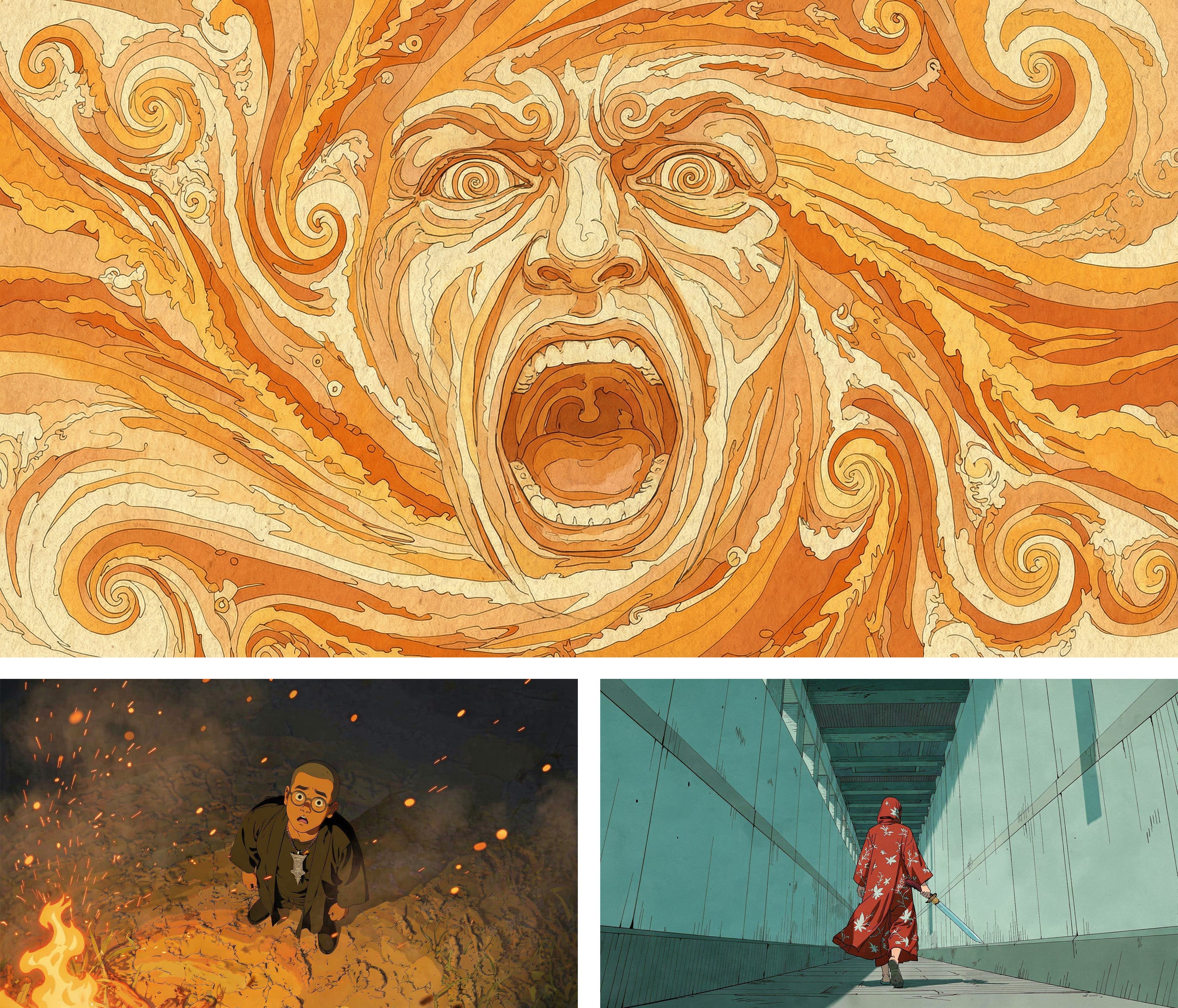
Lots of projects are underway at the moment, but my AI science fantasy film anthology and accompanying Tabletop RPG is probably the most exciting. Here’s a little look at pre-visualisations for Ignore all previous instructions_

Thanks for joining me on this journey. If you’d like to travel together again sometime…